Homophobic Attack: After the Violence, the Fear
Pierre Picavet, president of FLAG!, was seriously injured in a homophobic attack in Paris’s Marais district. Beyond the brutality of what happened, another question remains: what does an attack like this do to our own sense of safety?
There are stories we discover on the evening news. And then there are those we stumble across almost by chance, while scrolling through our phones.
That is how I discovered what had happened to Pierre Picavet.
And, to be honest, something about it deeply unsettled me.
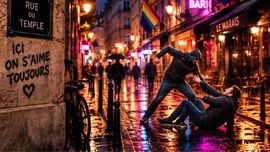
At around 4 a.m. on the night of Friday 28 to Saturday 29 August, Pierre Picavet, a police officer and president of FLAG!, an association fighting discrimination and anti-LGBT+ violence, particularly within France’s Interior and Justice ministries, was leaving a gay bar in the Marais district of Paris.
According to his account and information released by prosecutors, a man attacked him after repeatedly hurling homophobic insults at him. Pierre Picavet showed the man his police ID and told him he was a police officer.
It did not stop the attack.
He was struck, including with a bottle.
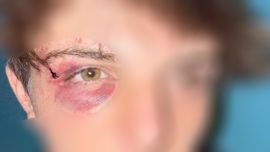
His injuries were severe: multiple fractures to his face and skull, intracranial bleeding and a fracture to his left eye socket. He was given 40 days of temporary incapacity for work.
But behind this clinical list of injuries, there is first and foremost a human being.
It took several days for the story to reach the evening news
The attack was not ignored by the media.
Articles appeared as early as Sunday. News channels subsequently reported on it. Pierre Picavet himself spoke about the attack on BFMTV. And on Wednesday 2 September, TF1 covered the case on its flagship 8 p.m. news programme.
And yet, I cannot shake one question.
Why did I — and probably others too — have the feeling that we discovered an attack of such severity mainly through social media?
This is not about deciding which journalists did or did not do their job. The news cycle has its own choices, priorities and pace.
Perhaps we should be asking ourselves something else.
Whether we are becoming accustomed to it.
A homophobic attack. Then another. An insult. A beating. An ambush. A few images on Instagram. A few lines in our feeds.
And then we keep scrolling.
That is precisely what I refuse to accept as normal.
Only a few months ago, we were already asking ourselves a similar question after the death of Noahm, a 19-year-old who died following a violent assault in Metz. His story made us reflect on what happens when violence briefly enters the news cycle before gradually fading from our collective memory.
→ After Noahm: A Life Lost, A Society Questioned
Because before he became a news story, he was a person
The photographs of Pierre Picavet’s injured face have circulated widely.
They bear witness to the violence he suffered. But I almost wish that now, we could look beyond those images.
Because Pierre Picavet is not simply “the man with the bruised face” that social media showed us for a few days.
He is a person. A police officer. The president of an association. Someone who devotes part of his life to fighting anti-LGBT+ violence and discrimination.
And in a few days, when the news cycle has moved on to something else, there will still be wounds to heal.
The ones we can see.
And probably those we cannot.
That, too, is what a homophobic attack leaves behind.
A judicial decision that can also leave us afraid
The alleged attacker, who was born in 2006, was arrested and subsequently placed under formal investigation for aggravated violence and theft. He disputes the homophobic nature of the attack and, like anyone accused of an offence, is presumed innocent.
He was placed under judicial supervision.
Among other restrictions, he is prohibited from entering Paris’s 3rd and 4th arrondissements, from contacting Pierre Picavet and from leaving metropolitan France. He is also required to report regularly to the police and undergo treatment for addiction.
But I have to admit that this decision does more than raise questions for me.
It frightens me.
Pierre Picavet says he heard his attacker tell him that he was going to kill him. He was struck, including with a bottle, briefly lost consciousness and woke up in the arms of a passer-by, of whom he later said: “You could say he saved me.” It was also this witness who enabled police officers at the scene to identify the alleged attacker.
So one very simple question comes to mind: after such violence, how can we not wonder whether the restrictions imposed under judicial supervision will actually be respected?
The justice system operates according to rules and procedures, and has access to evidence in the case that we do not. If those restrictions were breached, the judicial supervision could be revoked and the suspect could be remanded in custody.
I certainly do not pretend to put myself in the place of the courts.
But I can talk about what this decision makes me feel.
Today, I wonder whether I will feel quite as carefree tomorrow when walking alone through the Marais. Even in broad daylight. It is probably irrational. Statistically, I have little reason to believe that I will ever cross paths with this man. And even if I did, I do not even know what he looks like.
But fear does not always listen to statistics.
And more importantly, am I the only one who feels this way?
How many of us will now walk into a street in the Marais perhaps a little less carefree than before? How many will look over their shoulder a little more when walking home alone? How many will experience that tiny moment of hesitation that was not there before?
This is not to suggest that we are all afraid. But if this attack is enough to make some of us a little less free, a little less spontaneous, a little more vigilant in a neighbourhood where we should be able to feel at home, then its consequences already extend far beyond the injuries inflicted on Pierre Picavet.
Because one of the most insidious consequences of homophobic violence is precisely this: its ability to change our behaviour. To make us look over our shoulders. To make us hesitate before walking home alone. To make us avoid certain places or certain times of day. To make us think twice, once again, before showing the world who we are.
I do not know what the man who attacked Pierre Picavet intended to create. I will not attribute to him any motive that has not been established by the justice system.
But I do know what homophobia does when it succeeds in making us afraid.
It shrinks our freedom.
And after spending so many years coming out of the closet, it would be terrible if fear found another way to push us back inside.
To Pierre Picavet
At HappyGayTV, we try to talk about what can help LGBT+ people live happier, freer and more peaceful lives.
That freedom also depends on something extraordinarily simple: being able to walk down a street, leave a bar, go home, hold someone’s hand or simply be ourselves without having to wonder whether doing so could put us in danger.
That is why, beyond this news story and all the questions it raises, we would like to end by speaking simply to Pierre Picavet.
We wish him the speediest possible recovery. Above all, we hope he can rebuild himself, physically of course, but psychologically too, far from the images of his injured face that have circulated and from the media attention generated by this attack.
Our thoughts are also with his loved ones and the members of FLAG! who are supporting him.
In a few days, the news cycle will have moved on.
But we will continue to remember what happened that night.
Not because we want to live in fear.
But precisely because we refuse to let fear decide for us where we can go, whom we can love or who we are allowed to be.
To Pierre Picavet, we simply wish that he may regain that freedom as soon as possible.
What about you — has this attack changed anything?
Has this attack made you think about your own safety? Do you still feel just as free and relaxed when walking through the Marais — or anywhere else? Does this judicial decision raise questions for you, reassure you or, on the contrary, make you feel less safe?
The HappyGayTV Hot-Line is here for that too: so that the conversation does not end when the article does.
You can leave us your story in audio or video and share what this case has made you feel.
Reactions and stories from the community are available to members of the HappyGayTV Club.
Join the Club for free, be part of the conversation and, if you wish, share your voice on the Hot-Line.
Marco DRION
Illustration: HappyGayTV - All rights reserved
© HappyGayTV - September 2026